How Real Estate Developers Read the Cycle Before Everyone Else Does
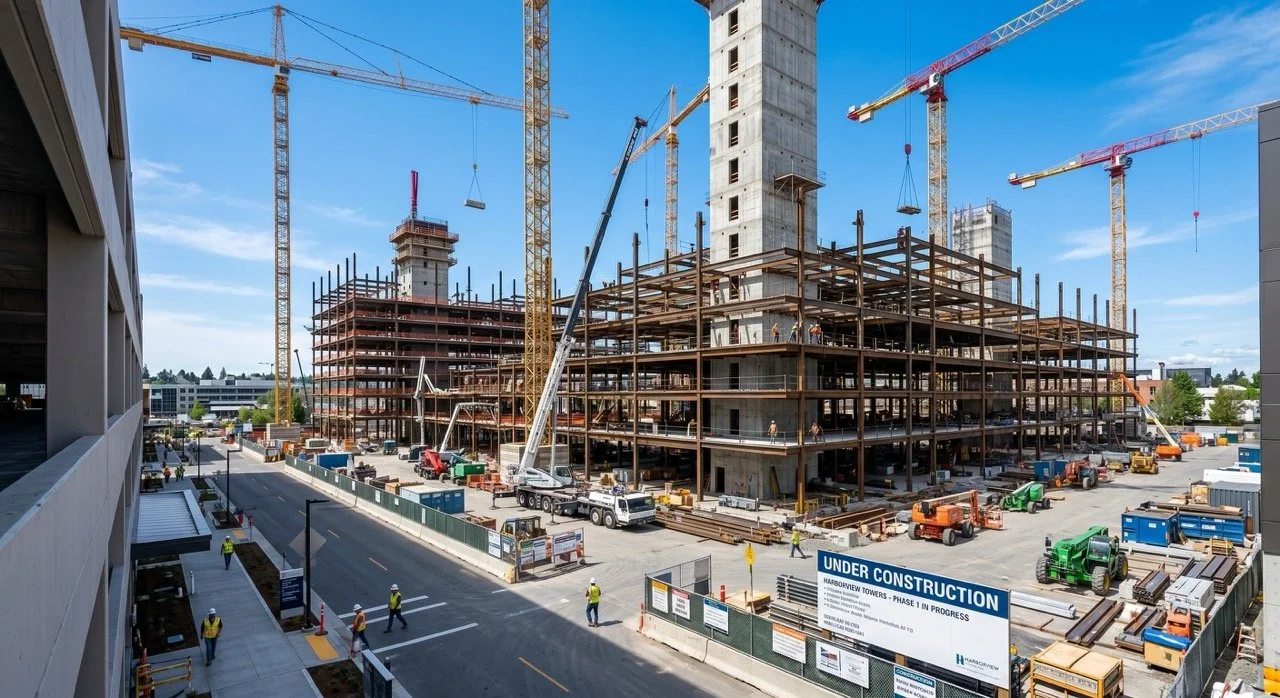
There's a famous observation in real estate development circles: the best time to start a project is when everyone thinks it's the worst time. The worst time to start a project is when everyone thinks it's the best time.
Like most maxims, it's an oversimplification. But it contains real insight about how development economics work — and why the discipline of reading the market cycle is one of the most valuable skills in the business.
Why Timing Is Structural, Not Tactical
Real estate development has unusually long lead times. A project that breaks ground today probably began as a site search two or three years ago. Entitlements, environmental review, design development, financing negotiation, and construction all unfold across years, not months. By the time a building opens, the market that existed when the developer made the initial decision may look very different.
This creates a structural challenge: developers have to make their most important capital decisions based on where they think the market will be in three to seven years — not where it is today. The developers who get this right consistently aren't just optimistic. They've developed a genuine discipline for reading market signals.
The History of Getting It Wrong
The 2007-2008 construction bubble is the most vivid recent example of cycle misreading at scale.
Condo development in Miami, Phoenix, Las Vegas, and parts of Florida reached frenzied levels between 2004 and 2007. Cranes dominated skylines. Pre-sales closed at prices that assumed continued appreciation. Developers who had seen nothing but upside for several years concluded that the market would continue to support what they were building.
The projects that opened in 2008 and 2009 walked into a market where sales prices had fallen 30-50%, pre-sale contracts were being defaulted on, and financing had largely evaporated. Properties that had been fully subscribed at launch sat vacant or were sold at enormous losses.
The same dynamic played out in the multifamily sector in the mid-1980s, when tax law changes (particularly the Tax Reform Act of 1986) pulled the investment thesis out from under enormous amounts of new apartment construction. Buildings financed for one tax environment opened into a completely different one.
In both cases, the developers who fared best were those who had paid attention to signals that the cycle was late — and had the discipline to hold back or adjust their underwriting accordingly.
What Experienced Developers Actually Watch
Cycle reading in real estate isn't prediction. It's pattern recognition applied to current data. Here's what experienced developers typically monitor:
Permit activity. When construction permit volumes in a market rise significantly above historical averages, supply is accelerating. If that supply arrives before demand catches up, vacancies will rise and rents or sale prices will soften. Developers who see permit surges often adjust their own timelines or underwriting assumptions accordingly.
Land pricing. When land prices rise faster than the improvements they can support, developers are paying for anticipated demand — not proven demand. Overpriced land compresses returns even in a healthy market, and destroys them in a correction. Watching land price trends is one of the earliest-available signals about cycle positioning.
Construction costs. In late-cycle markets, construction costs tend to rise sharply as labor and materials are absorbed by high development volumes. Rising construction costs compress margins and often make projects that penciled a year ago no longer viable at current land prices. This is a natural corrective mechanism — but it also signals how deep into a cycle the market may be.
Absorption data. In multifamily, how quickly new units lease up; in for-sale residential, how long homes sit before selling; in commercial, how quickly new leases are signed. Slowing absorption is an early signal that supply is getting ahead of demand.
Cap rate trends. In commercial and multifamily investment, cap rate compression (prices rising faster than income) signals strong investor demand for assets — often a late-cycle condition. When cap rates are near historical lows and construction is accelerating, the risk profile of new development is elevated.
None of these signals, taken alone, is definitive. Read together, over time, they tell a story about where the market sits in its cycle.
Adaptation as the Core Skill
The developers who perform well across full cycles tend to share one characteristic: they adapt their strategy to where they are in the cycle rather than pursuing the same approach regardless of market conditions.
In early-cycle markets — when vacancy is high, financing is cautious, and confidence is low — they take calculated risks that others won't. They buy land at distress prices, pursue entitlements on undervalued sites, and begin development when the completion date aligns with recovery.
In mid-cycle markets — healthy demand, reasonable supply growth, improving fundamentals — they move steadily, expanding capacity without overextending.
In late-cycle markets — low vacancy, rising costs, aggressive competition for sites — they slow down. They become more conservative in their underwriting, sell assets rather than buying them, and wait for the correction that history says will come.
This isn't pessimism. It's professionalism. The developers who survive multiple cycles and build lasting firms aren't lucky. They've developed the discipline to read where they are — and the patience to act accordingly.
The Long View
At Atrium, development is approached as a long-horizon business. The projects we pursue are ones we believe in over a full cycle, not just at the moment of underwriting. That requires honest market analysis, conservative assumptions, and the willingness to pass on opportunities that don't hold up when the cycle eventually turns.
The real estate cycle doesn't repeat identically. But it rhymes reliably enough that the history is worth knowing — and the signals are worth watching.
Atrium Management Company provides commercial brokerage, property management, and real estate development services. Learn more here.
Atrium Wordle #020
Another Wordle for you. Five letters. Real estate themed because it’s our thing and we like it. Good luck. You got this. Share your results with #atriumwordle.