What a 1926 Supreme Court Case Tells Us About Development Today
2 min read • July 21, 2026
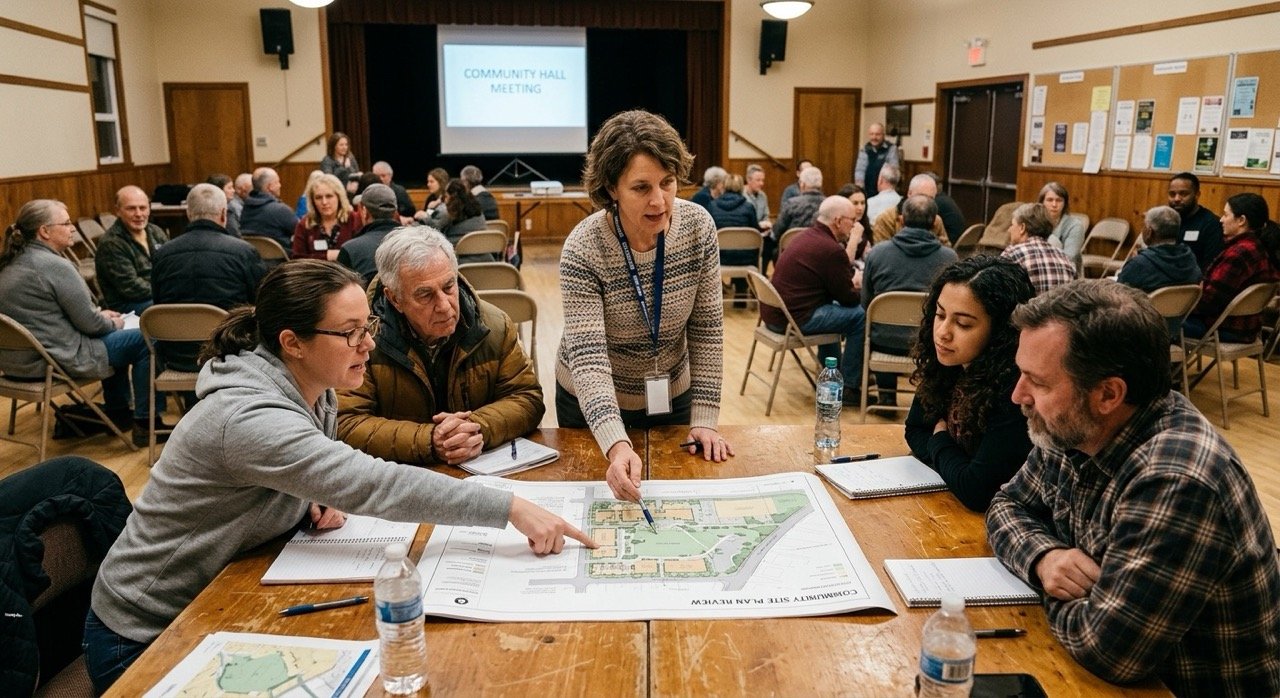
In 1926, a small Ohio company called Ambler Realty took the village of Euclid to the Supreme Court. Euclid had passed a zoning ordinance restricting what could be built on Ambler's land, and Ambler argued this destroyed the property's value. The Court sided with Euclid. That case, Village of Euclid v. Ambler Realty, is the reason zoning is constitutional in America today.
Here's the part that gets missed. Euclid didn't pass that ordinance in a vacuum. A community wanted a say in what got built near them, and they got the legal tools to make that say enforceable. The entire zoning system that developers work within was created because community pushback is a normal, expected part of building anything. It's not a modern inconvenience. It's older than almost every other part of the development process.
What's changed is the scale of the fight
Community opposition today shows up fastest and loudest around the newest kinds of development. Data center projects worth roughly $130 billion had been blocked or delayed by early 2026, and cancellations climbed from about six in 2024 to twenty-five in 2025. Residents in one Missouri town blocked a $1.5 billion project outright. A $24.7 billion project in Virginia sits delayed right now.
Those are extreme numbers for a different asset class, but the underlying lesson applies everywhere. Opposition that surfaces during a public hearing, after land has been cleared and financing lined up, is the most expensive place to discover a problem. Every extra month of permitting cascades through construction schedules, financing terms, and vendor commitments.
Why the timing matters more than the opposition itself
The developers who navigate this well share one habit: they treat community concerns as a site evaluation question, answered early, not a communications problem, solved late. Traffic patterns, school capacity, noise, the character of a neighborhood that took decades to form, these concerns don't disappear because a project got announced. They organize. Neighbors find each other, retain counsel, show up to hearings.
None of that means every project gets welcomed once concerns are addressed. It means the conditions for how a project will be received are mostly knowable before a shovel goes in the ground, if someone actually goes and asks.
What this means for how Atrium develops
We plan for this stage the same way we plan for financing or entitlement timelines. Not because pushback is guaranteed, but because it's a normal, predictable part of the process, the same way it's been since the legal framework for development itself was written. A project that accounts for community input early moves faster and costs less than one that treats it as an afterthought.
The history is a century old. The lesson hasn't changed.
Want to understand how Atrium approaches a new project from day one, community included? Learn more here.
Atrium Management Company provides property management, commercial brokerage, and real estate development services. Learn more here.
Atrium Wordle #025
Another chance to Wordle. See if you can solve it and find the connection to what we do. Share your results with #atriumwordle!