

One North Orange: The Bank Building That Watched Orlando Grow Up
In 1924, a 10-story bank tower rose at the corner of Orange and Central. A century later, it's waiting on its next chapter.
In 1920, Orlando had 9,282 residents. Most of downtown was two and three stories tall, and the city was best known for oranges.
Then the Florida land boom hit. Starting around 1921, people poured into the state so fast that one local historian described them as "swarming into Florida like locusts." Orlando's population doubled in five years and nearly tripled by 1930. A growing city needed somewhere to keep its money, and it needed buildings that looked like they belonged in a real city.
Orange Avenue answered with steel.
Three towers in two years.
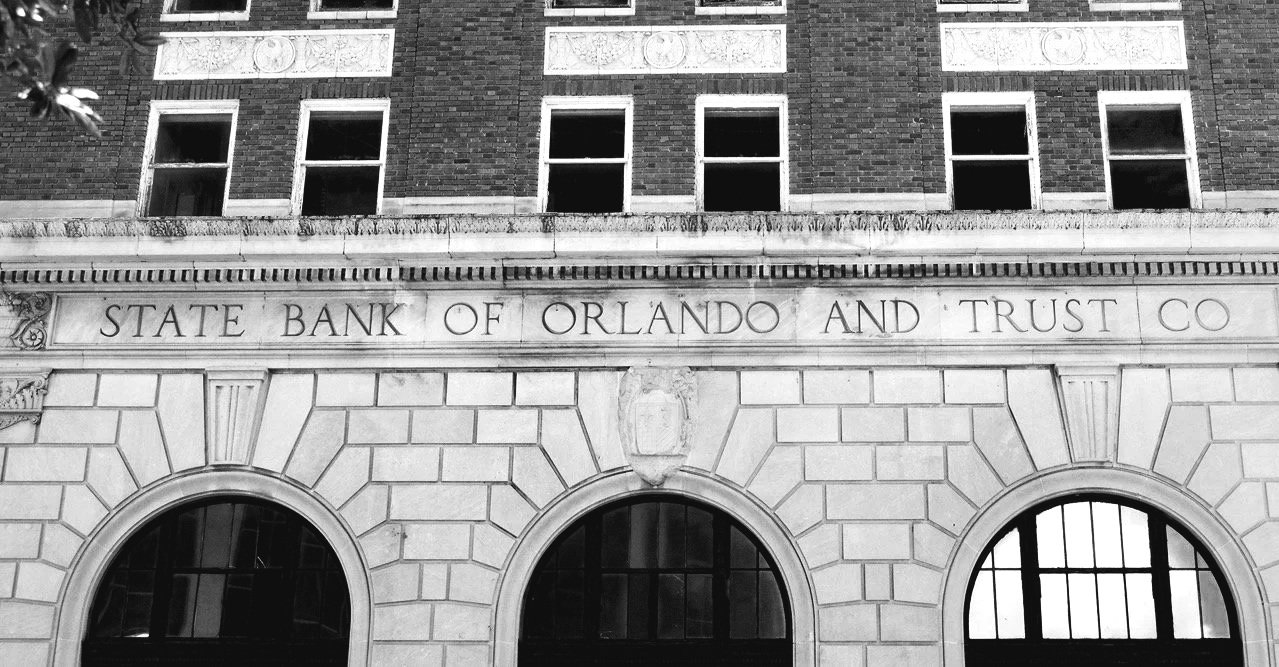
Between 1923 and 1924, three buildings went up along Orange Avenue that changed the downtown skyline. The Angebilt Hotel opened in 1923 at 11 stories and briefly held the height record. The Orlando Bank & Trust building went up a block south in 1924. And at the corner of Orange Avenue and Central Boulevard, the State Bank of Orlando & Trust Co. finished its new headquarters: a 10-story neoclassical tower at 1 North Orange.
The bank behind it already had history. It was organized in 1893, which made it one of Orlando's oldest. Two years later it survived the Great Freeze of 1895, when back-to-back cold snaps wiped out most of Central Florida's citrus crop. Two other Orlando banks didn't make it through. The State Bank did. By 1919 it had become the State Bank & Trust Company. Its new building was a statement that the bank, and the city, planned to stick around.
The architect was W.L. Stoddart, a hotel designer with offices in New York and Atlanta. The builder was A.G. Bentley, who also built the Orlando Bank & Trust tower down the street. Stoddart gave the building the look of the era: a solid base at street level, a clean shaft of offices above, and the kind of steel-frame height that only a few years earlier would have seemed out of place in a citrus town.
The bank didn't last. The building did.
The boom ended almost as fast as it started. Florida's land market collapsed in 1926, and the Great Depression followed. The State Bank closed in 1929, just five years after moving into its tower. In 1933 the Florida Bank at Orlando took over the property, and the corner kept serving as a bank for decades after.
That's the pattern with buildings like this one. Businesses come and go, and the structure outlasts them. In 1973, Orange County government bought the building and filled it with county offices. In the early 2000s, it served as the temporary home of Florida A&M University's College of Law while the school's permanent downtown campus was being built.
Then things got quiet. Orange County sold the building in 2007 to a buyer who talked about a rooftop restaurant that never came. It sold again in 2011. Through all of it, the tower sat mostly empty for more than 15 years, while downtown grew up around it with new apartments, a performing arts center, and a soccer stadium.
A survivor.
Of the towers that rose during Orlando's 1920s boom, only three still stand downtown: the Angebilt, the Orlando Bank & Trust building, and One North Orange. Much of the 1920s layout is still intact inside, including the basement, the original elevator and stair core, and the long rectangular floor plates that made it a practical office building a century ago.
That matters more than it might seem. Buildings from this era were built with heavy structure and generous proportions, and they can't be recreated today at any reasonable cost. Once one is gone, the city doesn't get it back.
The next chapter.
In 2025, the City of Orlando's Community Redevelopment Agency bought One North Orange as part of a larger plan to bring life back to the blocks around Lake Eola. The city doesn't want to run the building. It wants a partner who will restore it and give it a new purpose.
This fall, the agency released its formal call for proposals. The city is looking for a long-term lease partner to redevelop the tower through adaptive reuse. That means keeping the historic building and giving it a new job. The ideas on the table include a ground-floor restaurant or café, a rooftop bar, and a boutique hotel. Cities like Atlanta and Charleston have done this well with buildings from the same era. Atlanta's Georgian Terrace and Charleston's Francis Marion Hotel are both 1910s and 1920s landmarks that found second lives as hotels.
Atrium Commercial Real Estate and First Capital Property Group are working with the city to market the opportunity and find the right partner. For our team, it's a rare assignment. Most listings are about square footage, rates, and traffic counts. This one is about a corner that has stood at the center of downtown Orlando for a hundred years, through a land boom, a bust, a depression, and a long, quiet stretch, and is now ready for whatever comes next.
Interested in the One North Orange opportunity? Contact Atrium Commercial Real Estate or visit fcpg.com/one-north for the offering memorandum and solicitation details.